Land the Joke Without a Caption: What Stand-Ups Know About Visual Timing

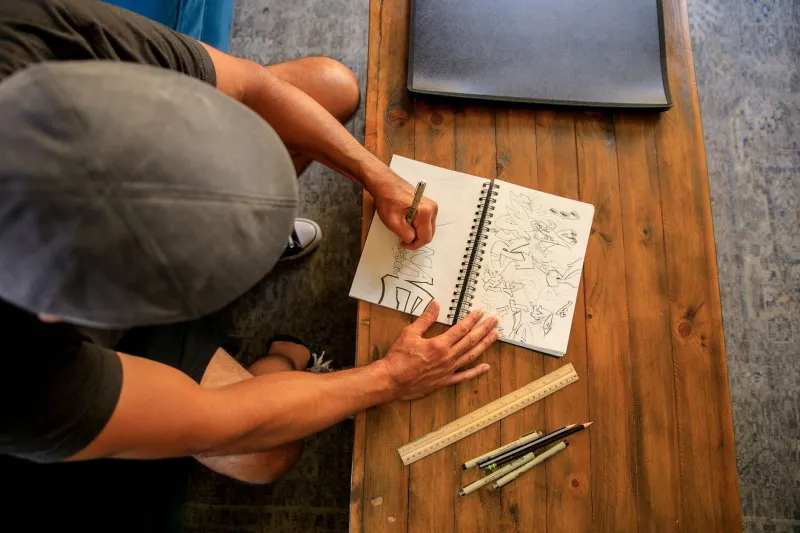
Photo: Mhart3000, CC BY-SA 4.0, via Wikimedia Commons
A comedian walks onstage, says one sentence, and waits. Two seconds. Three. The room leans forward. Then the punchline detonates.
Now look at a good single-panel cartoon. Same structure, different physics. The setup is what the eye sees first. The pause is the negative space between the elements. The punchline is what the eye finds second, and the whole joke lives or dies on whether that second thing arrives at the right moment.
Illustrators talk about composition and value and gesture, and all of that matters, but almost nobody talks about timing. Which is strange, because timing is the entire job.
Setup, pause, payoff
Stand-up has a rhythm you can diagram: premise, beat, turn. The premise establishes a normal. The beat lets the audience settle into it. The turn breaks the normal in a way that was technically available the whole time.
Visual storytelling runs the identical sequence, except the beat is spatial. A wide shot with a figure in the corner: premise. Empty middle ground: beat. The thing behind the door: turn.
When a drawing feels flat, it is usually missing the beat. The artist packed the setup and the payoff right against each other, so the viewer's eye slides from one to the other with no gap to build anticipation in. Comedy needs that gap like a fire needs air.
Your eye has a laugh line
Viewers do not read an image all at once. They land somewhere, usually on the highest contrast or the nearest face, and then they travel. That travel is your timing.
You control it with contrast, sharpness, color saturation, and eyes. Eyes are the strongest magnet in any composition, which is why a character staring at something off-panel is such a reliable engine: the viewer follows the gaze and walks straight into the punchline.
Gary Larson did this constantly. The setup is a group of cows standing in a field, and the payoff is one cow whispering to another, and the timing comes from how much empty pasture you have to cross to get from the wide establishing shot to the tiny bit of dialogue. That space is a comedian's pause, drawn.
Negative space is the pause, not the leftovers
Most beginners treat empty area as the part they did not fill in. Comedians treat silence as a tool they schedule.
A pause that goes on a beat too long becomes awkward. A pause that is too short gets stepped on. Same rules apply. If your negative space is doing no work, it reads as an unfinished background. If it is holding the viewer's eye just long enough for the second element to register, it reads as timing.
Comics artists know this better than anyone. The gutter between panels is a rest, and a rest is not the absence of music. It is part of the music.
Never explain the bit
Here is the fastest way to kill a joke in illustration: put a caption under it that describes what you drew.
Stand-ups have a term for a comic who explains the punchline, and it is not a compliment. The audience's small moment of discovery is the reward. Take it away and you have delivered information instead of a joke.
So test your images the way comics test material in small rooms. Cover the caption. Does the image still land? If yes, the caption is decoration and probably unnecessary. If no, the image has a setup problem, not a caption problem, and no amount of clever text will fix a composition that hides its own payoff.
Then try the reverse. Uncover the caption. Does it add a second turn, or does it just repeat the first one? The best captions in cartooning are not labels. They are a second beat, delivered after the viewer thought the joke was over.
The clapter problem
Comedians dread a specific sound called clapter: applause instead of laughter. It happens when the audience agrees with the sentiment instead of finding the thing funny. You get rewarded without being good.
Illustrators have their own version. It is the image that gets a lot of likes because the subject is wholesome, or sad, or cool, or a recognizable character. Nothing was actually built. The reaction came from the reference, not from the craft.
The fix is the same one comics use: strip the reference and see what is left. Remove the nostalgic property, the cute animal, the devastating subject matter. Does the composition still produce a reaction? Does the timing still work on a viewer with no context?
If it does, you have a joke. If it does not, you have a poster.
Three drills worth stealing
First, redraw a panel you like with the punchline element moved closer to the setup. Watch how much funnier it gets when you give the eye room to travel.
Second, build a single image where the joke requires three stops: a figure, then a clue, then a consequence. Three is the classic rhythm for a reason.
Third, sit with an image for a full minute before deciding it is done. Comics cut laughs by rushing. Most drawings are killed the same way, by an artist who filled the pause instead of trusting it.
The punchline was never the problem. The problem is almost always the two seconds before it.