Paper Doesn't Judge: Why Successful Illustrators Keep a Secret Sketchbook Life

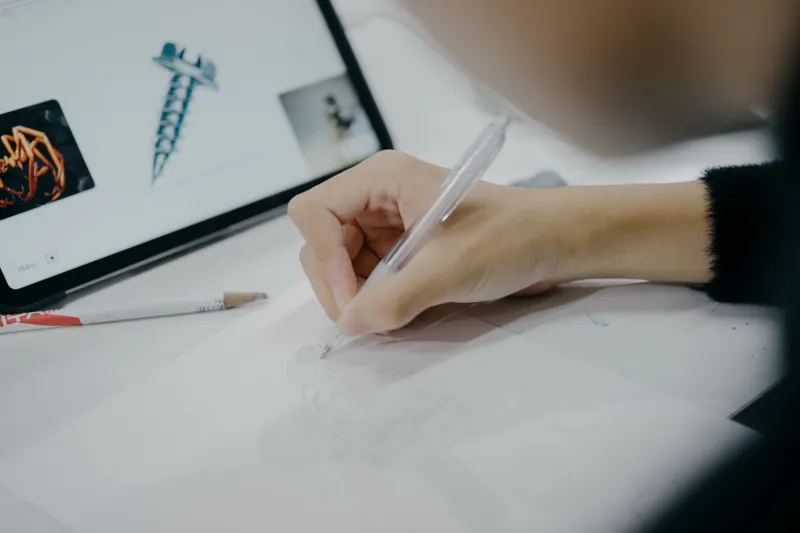
Photo by Photo by Goashape Studio on Unsplash on Unsplash
There's a sketchbook sitting on Mara Chen's desk right now. The cover is warped from a spilled coffee incident she'd rather not relive. The pages are thick with graphite smears, half-finished faces, and at least three different attempts at drawing a horse that all went sideways in different ways. She has 40,000 Instagram followers who will never, ever see it.
"That's kind of the whole point," she says.
Mara is a character designer who's worked on animated series and children's book projects across the US. Her digital work is clean, intentional, and client-ready. Her sketchbooks are none of those things—and she insists that's exactly why they matter.
This is a story about the private analog lives of professional illustrators. The drawings that don't make it to Behance. The pages that exist purely for the person holding the pencil. And why, in an industry increasingly dominated by Procreate and Photoshop, so many working creatives are still reaching for something with no undo button.
The Freedom in the Unfixable
Here's the thing about digital art tools: they're extraordinarily forgiving. You can paint over mistakes instantly. You can duplicate layers, experiment on copies, and roll back hours of work with a single keystroke. That forgiveness is genuinely useful when you're on deadline or iterating toward a client's vision.
But some artists argue that all that forgiveness has a hidden cost.
"When I know I can undo, I take risks differently," says Portland-based illustrator and graphic designer Theo Vasquez. "There's this low-stakes mentality that creeps in. I'll try something weird, and if it doesn't land, I'll just go back. But in a sketchbook? That mark is there. I have to figure out how to live with it—or work with it."
That necessity-driven problem-solving is something multiple illustrators brought up unprompted. When you can't erase, you start making different decisions. You commit more. You improvise more. And sometimes—more often than logic would suggest—the marks you were forced to keep become the most interesting ones on the page.
Graphic novelist and visual storyteller Sasha Okafor describes it as "creative judo." You take the weight of the mistake and redirect it. A line that went too far becomes the edge of a shadow. A proportion that's off becomes an expressive exaggeration. "Some of my most distinctive character quirks came from me trying to rescue a drawing that was falling apart," she says.
The Psychology of Nobody Watching
There's a term in psychology called "evaluative apprehension"—the way people modify their behavior when they know they're being observed or judged. Social media has essentially turned artistic practice into a performance, whether creators intend it that way or not. Even a casual WIP post invites feedback, comparison, and the subtle pressure to produce work that will land well with an audience.
The private sketchbook removes all of that.
"I don't perform in my sketchbooks," says Mara. "I'm not thinking about whether something is 'on-brand' or whether it fits my aesthetic. I'm just drawing. And that sounds simple, but it's actually really hard to get back to once you've been making work for an audience for a while."
For many illustrators, the physical act of picking up a pencil—rather than opening a tablet app—serves as a kind of psychological signal. It says: this is not for output. This is not for posting. This is thinking.
Theo keeps his sketchbooks in a drawer, not on a shelf. "If they're visible, I start thinking of them as objects that exist in the world. I want them to feel like internal documents."
Where the 'Real' Work Begins
Here's the paradox that keeps coming up in conversations with working illustrators: the work that nobody sees often becomes the foundation for the work that everyone sees.
Sasha points to a graphic novel chapter she finished last year—one that received significant praise for its expressive character work—and traces it back to a sketchbook session she did on a slow Sunday morning. "I was just drawing faces. Not for anything. And I hit on this way of drawing exhaustion around the eyes that I'd never done before. That expression ended up in the book. It became kind of a signature moment."
This isn't unusual. The low-pressure, non-goal-oriented nature of private sketching creates conditions where genuine experimentation can happen. You're not trying to solve a client brief. You're not trying to finish a piece. You're just drawing, which means you're more likely to wander into territory you'd never deliberately seek out.
Theo describes his sketchbooks as a "vocabulary builder." Every session adds new marks, new approaches, new ways of solving visual problems. "By the time I sit down at my tablet, I've already done a lot of the thinking. I just didn't know that's what I was doing at the time."
Starting (or Restarting) Your Own Practice
If you've drifted away from analog sketching—or never really built the habit—the barrier to entry is genuinely low. A few thoughts from the artists we spoke with:
Don't buy a fancy sketchbook to start. Mara specifically recommends against it. "If the book is too nice, you'll be afraid to mess it up. Get something cheap. Ugly paper. Spiral bound. Something you feel zero obligation to."
Give yourself a time container, not a goal. Instead of deciding to "fill three pages," set a timer for 15 minutes and draw whatever. The absence of a goal is part of what makes it work.
Keep it off your phone. Sasha's rule: sketchbook drawings don't get photographed unless she's actively referencing them for a project. "The moment I start thinking about documenting it, the vibe changes."
Let it be bad. This one sounds obvious, but it's harder than it sounds for people who've spent years developing craft and standards. Bad drawings in a private sketchbook are not failures. They're data. They're process. They're yours.
The Pencil as Permission Slip
There's something almost countercultural about a professional illustrator in 2024 insisting that their most important creative tool is a 99-cent pencil and a $6 sketchbook. But the more you talk to working creatives, the more it starts to make sense.
The digital tools are for making. The sketchbook is for being. And in an industry where the pressure to produce, post, and perform is relentless, having a space that exists entirely outside of that economy isn't just nice to have. For a lot of illustrators, it's what keeps the whole thing alive.
"My sketchbooks are where I'm still a kid who just likes to draw," Mara says. "And I think that kid is doing more for my career than I give her credit for."